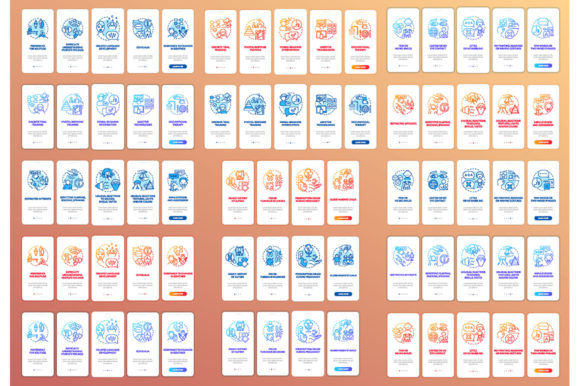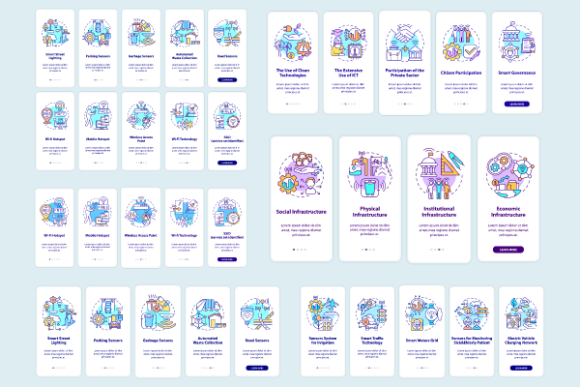
Smart City Technologies App Page Bundle: Strategic Design Assets for Urban Innovation
In the rapidly evolving sector of urban technology, the gap between complex infrastructure and user accessibility is often bridged by interface design. The Smart City Technologies App Page Bundle serves as a critical resource for professionals tasked with translating sophisticated municipal systems into intuitive mobile experiences. This collection is not merely a set of graphical assets; it is a strategic toolkit designed to accelerate the visualization of smart control systems, IoT management dashboards, and citizen engagement platforms. For entrepreneurs, product managers, and designers working in the civic tech space, leveraging this bundle allows for rapid prototyping and high-fidelity stakeholder communication without the overhead of building UI components from scratch.
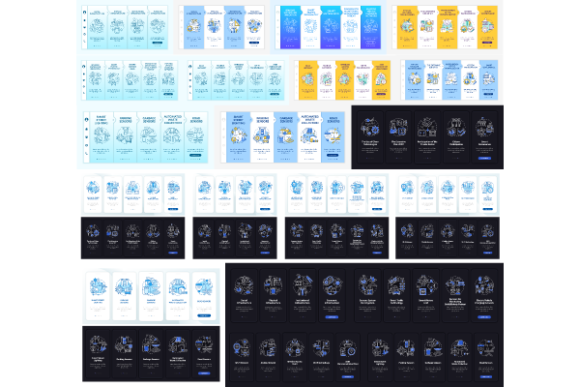
The strategic value of this bundle lies in its specificity. Generic UI kits often fail to capture the unique data density and functional requirements of smart city applications. By utilizing a specialized Smart city technologies onboarding mobile app page screen bundle, teams can immediately address the specific friction points associated with adopting new urban technologies. Whether you are pitching a waste management optimization system to city council members or designing a public transit companion app for daily commuters, having pre-structured, context-aware screens ensures that your design decisions are grounded in industry relevance rather than abstract aesthetics.
Accelerating Product Planning and Stakeholder Alignment
One of the most significant challenges in smart city projects is aligning technical engineers, government officials, and end-users around a shared vision. Technical specifications rarely inspire confidence in non-technical decision-makers, while wireframes can sometimes feel too abstract to convey the final value proposition. The Smart City Technologies App Page Bundle functions as a high-fidelity communication bridge during the planning phase. By deploying these vector templates early in the discovery process, product teams can facilitate more concrete feedback loops.
When stakeholders can interact with or view realistic representations of a "Smart control system walkthrough," they are better equipped to identify gaps in logic or user flow before development begins. This shifts the conversation from theoretical capabilities to practical usability. For example, if the bundled onboarding screens reveal that a sensor calibration process requires too many steps for a field technician, the team can restructure the workflow during the design phase rather than during costly post-launch updates. This proactive approach to planning reduces scope creep and ensures that the final product aligns with both operational realities and user expectations.
Visualizing Complex Workflows Through Structured Instruction
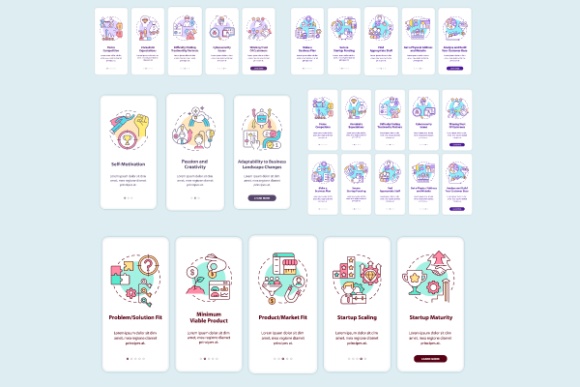
Adoption is the primary metric of success for any smart city initiative. If citizens or municipal workers cannot understand how to use a system, the technology fails regardless of its backend sophistication. A core component of this asset collection is the Smart control system walkthrough 5 steps graphic instructions with concepts. These are not decorative elements; they are pedagogical tools designed to reduce cognitive load.
Effective onboarding in a smart city context differs significantly from consumer apps. Users may be interacting with these systems under stress, in poor lighting conditions, or as part of a mandatory compliance workflow. The five-step instruction graphics included in this bundle provide a proven framework for breaking down complex tasks into digestible actions. When integrating these assets, consider the following strategic applications:
- Cognitive Chunking: Use the five-step structure to enforce discipline in your UX writing. If a task cannot be explained in five visual steps, it likely needs to be simplified or automated further.
- Contextual Relevance: Adapt the linear color illustrations to reflect the actual hardware or environment the user will encounter, reinforcing the connection between digital instruction and physical action.
- Accessibility Compliance: Utilize the vector nature of these graphics to ensure high contrast and scalability, meeting WCAG standards essential for public sector software.
- Multilingual Adaptation: Because the instructions are concept-driven and visual, they serve as a universal baseline that can be easily localized for diverse urban populations without redesigning the entire layout.
Technical Versatility and Production Efficiency
From an operational standpoint, the file format diversity—JPEG, AI, PNG, EPS, SVG—is a major efficiency driver. In professional design workflows, interoperability is key. The inclusion of AI and EPS files allows designers to fully customize the UI, UX, GUI vector template with linear color illustrations within Adobe Illustrator or similar vector software, ensuring brand consistency across all touchpoints. Meanwhile, SVG formats are essential for modern web and app development, allowing for crisp rendering on any device size without increasing load times—a critical factor for users accessing city services on older devices or limited data plans.
PNG and JPEG exports provide immediate utility for marketing teams, grant proposals, and internal documentation where editable source files are unnecessary. This multi-format availability means that a single purchase supports multiple departments simultaneously. Marketing can use the high-res JPEGs for brochures and pitch decks, while the product team uses the AI files for interface design, and the development team references the SVGs for implementation. This consolidation of assets streamlines the supply chain for digital resources, reducing the administrative burden of managing disparate licenses and file sources.
Strategic Risks and Intentional Implementation
While the Smart City Technologies App Page Bundle offers significant advantages, relying on it without clear goals can lead to generic outcomes. A common risk is "template dependency," where the available screens dictate the product features rather than user needs driving the design. To avoid this, treat the bundle as a foundation, not a blueprint. Conduct independent user research to validate that the pre-designed flows actually match your target audience's mental models.
Furthermore, be mindful of the aesthetic uniformity that can arise from using stock UI kits. Smart city brands must convey trust, authority, and local identity. Simply applying the default linear color illustrations may result in an interface that looks indistinguishable from competitors. Strategic customization is mandatory. Adjust the color palette to match municipal branding guidelines, modify iconography to reflect local landmarks or specific infrastructure types, and rewrite microcopy to match the tone of voice established in your communications strategy. The goal is to leverage the structural efficiency of the bundle while infusing it with the unique character required for public trust.
Enhancing Long-Term Value with Comprehensive Resources
Sustainable design operations require reliable partners who understand the niche. BSD studio provides a variety of products, topics and file types so that there’s always something new to support evolving project requirements. When selecting design assets for long-term projects, consider the vendor's depth of catalog. A provider that specializes in smart city and tech themes is more likely to release updates and complementary assets that remain relevant as the industry matures.
Count on us in search for icons, brochure templates, infographic elements, mobile app screen pages and so much more. This breadth of offering allows teams to maintain visual consistency across different media types. A smart city campaign might span a mobile app, a printed annual report, a web dashboard, and physical signage. Sourcing these elements from a cohesive ecosystem like BSD studio ensures that the visual language remains unified, reinforcing brand recognition and professionalism. Find what you need in our shop to make sure you are saving time on design work while keeping up top quality. Time saved on asset creation is time reinvested in user testing, stakeholder engagement, and refining the actual service delivery that impacts citizens' lives.
Making the Decision to Invest
Ultimately, the decision to acquire the Smart City Technologies App Page Bundle should be based on a cost-benefit analysis of your current design velocity versus your roadmap demands. If your team spends excessive hours drawing standard toggle switches, map overlays, or onboarding sequences, this bundle offers an immediate ROI. However, if your project requires highly bespoke interactions that deviate significantly from standard smart city patterns, use the bundle selectively as a reference point rather than a direct solution.
Approach this resource with intentionality. Map out your user journeys first, then identify where the bundle’s assets can fill gaps or accelerate production. Use the Smart city technologies onboarding mobile app page screen bundle to solve known adoption barriers, and leverage the Smart control system walkthrough 5 steps graphic instructions to standardize training materials. By integrating these assets strategically, you move beyond simple decoration and toward building robust, user-centered urban technology solutions that stand the test of real-world deployment.